

Most people only think about their satellite dish when something goes wrong. The picture starts pixelating during the climax of a film, channels drop in and out during a downpour, or the signal cuts out completely on the night your favourite show is on. In nearly every case the underlying cause is the same: the dish is no longer perfectly aligned with the satellite it is supposed to be receiving from.
Dish alignment is one of those jobs that sounds simple but is actually a matter of millimetres. A dish that is a fraction off in azimuth or elevation can still appear to work fine on bright dry days, then fall apart the moment there is any weather. At R and G Satellite Services we have realigned thousands of dishes across Walsall, Wolverhampton, Cannock, Birmingham and the wider West Midlands over more than 20 years, and the issues we see are remarkably consistent.
Why Alignment Matters So Much
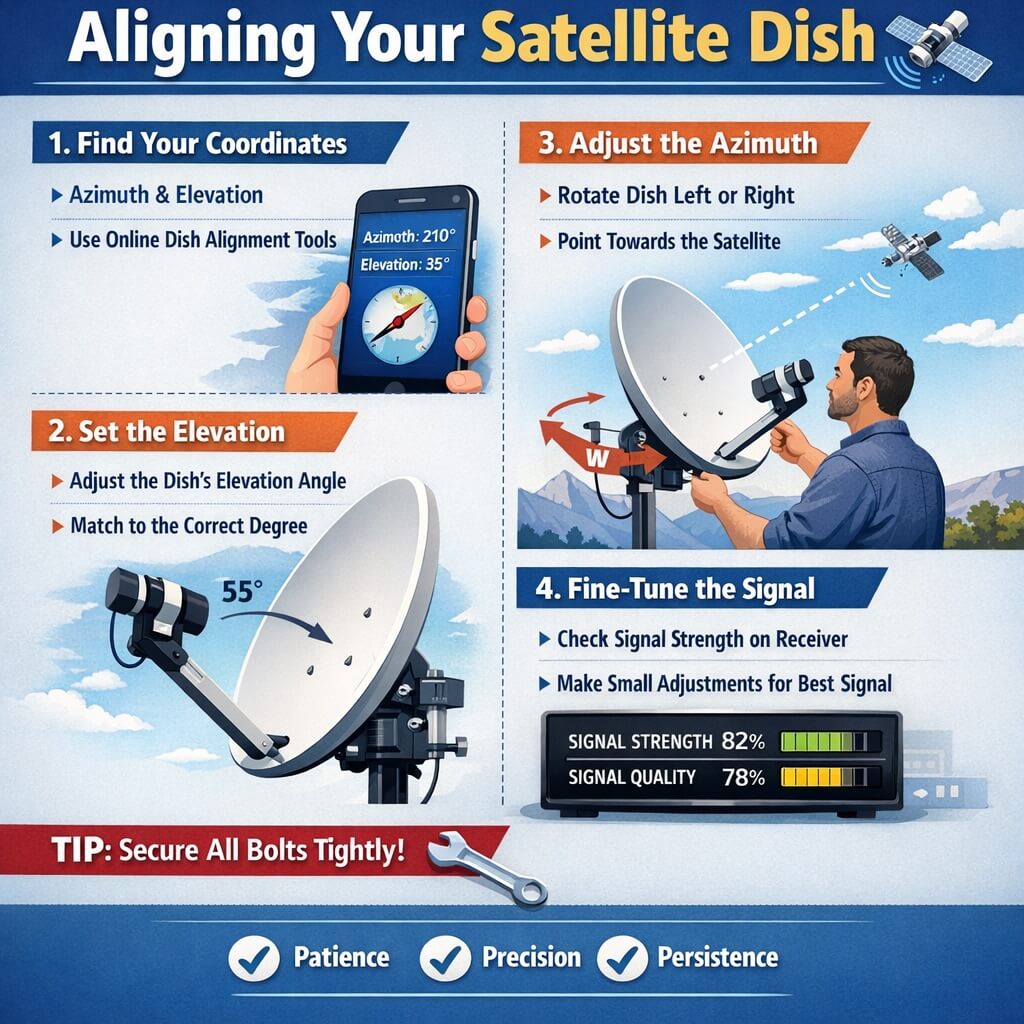
A satellite dish doesn’t catch a broad swathe of signal from space. It is a precision reflector designed to focus a very specific signal from a satellite sitting in geostationary orbit roughly 22,000 miles above the equator. For UK Sky and Freesat customers that satellite is Astra 2 at 28.2 degrees east. From our point of view here in the Midlands it sits low in the southern sky.
The dish has to be angled so that the reflected signal lands exactly on the LNB (the little arm sticking out in front of the dish). If the dish moves even slightly, that focal point shifts and the LNB picks up a weaker signal. A weaker signal means lower signal quality, and once the quality drops below a certain threshold the receiver simply cannot decode it and you get freezing, blocking or no picture at all.
The frustrating thing is that signal strength and signal quality are two different measurements. A dish that is poorly aligned can still show decent signal strength on the box’s diagnostic screen while the quality reading is too low to actually watch anything. This catches a lot of DIY installers out.
What Knocks a Dish Out of Alignment
Once a dish has been properly aligned and tightened it should stay put, but plenty of things in the real world can shift it:
Wind and weather. The West Midlands gets its share of strong winds, especially in autumn and winter. A dish that has been in place for several years will have had its bolts gradually loosened by the constant micro vibrations of being buffeted. Even a few millimetres of movement is enough to cause problems.
Birds and wildlife. Gulls, pigeons and even squirrels treat satellite dishes as convenient perches. Bigger birds landing on the LNB arm can knock things out, and bird droppings on the reflector surface affect signal in their own right.
Sports balls. Football, cricket ball, tennis ball, it doesn’t matter. We have seen dishes shunted out of position by everything from a stray garden game to a child’s drone.
Ladders and tradespeople. Window cleaners, painters, roofers and chimney sweeps all use ladders that pass close to dishes. Nine times out of ten there is no contact, but it only takes the lightest knock to shift the alignment.
Building movement and settlement. On older properties, particularly those with rendered or pebbledashed walls, the fixing point itself can loosen over time.
Vegetation growth. This one is sneaky. A tree or large shrub that was clear of the line of sight five years ago can grow enough to start blocking part of the signal. The dish hasn’t moved, but the path to the satellite is no longer clear.
The Symptoms of a Misaligned Dish
Some signs are obvious, others are easy to miss until they get worse:
- Pixelation or blocking on the picture, especially during rain or wind
- Channels freezing for a few seconds at a time
- “No signal” or “Searching for satellite” messages appearing intermittently
- Some channels work fine but others, particularly HD ones, drop out
- The picture is fine on dry calm days but fails the moment the weather turns
- Audio glitches or stutters even when the picture looks okay
- A noticeable drop in performance after a storm or strong winds
If any of these sound familiar, your dish alignment is the first thing to check.
Why Realignment Isn’t a Job for the Ladder in the Shed
We understand the temptation to have a go yourself. It looks straightforward enough from the ground. In practice there are several reasons why a professional realignment is the safer and more reliable option.
First there is the work at height issue. A satellite dish is almost always mounted somewhere awkward, often on a chimney stack, a gable end or the wall under the eaves. Working on a ladder while trying to make precise adjustments with one hand is exactly the kind of situation that ends in a fall.
Second there is the measurement issue. Without a proper satellite signal meter you are essentially guessing. The meter we use gives us live readings of signal strength, signal quality and the specific satellite the dish is currently pointing at. Trying to align by eye, or by running back inside to check the TV after every tweak, takes hours and rarely gets you to the optimum point.
Third there is the question of what you actually find when you get up there. Loose bolts, corroded brackets, water ingress in the LNB, damaged cabling, perished weatherproofing on the connections. A proper realignment service includes a check of everything, not just the dish angle.
Opening Up New Possibilities
Realignment isn’t only about fixing problems. It can also be about expanding what you receive. The same dish that picks up Astra 2 for Sky and Freesat can be reconfigured or supplemented to receive signals from satellites carrying European, Asian and other international broadcasts.
If you are originally from elsewhere in Europe or further afield and miss the channels from home, a dish realignment or a second dish installation can bring you Polish, Italian, French, German, Arabic, Greek and many other broadcasts. We cover this in detail on our foreign satellite TV installation page.
For households with motorised dishes, alignment is even more critical because the dish needs to track accurately across multiple satellites. If you have an older motorised setup that has gradually drifted, a proper recalibration can bring it back to life.
How R and G Can Help
We offer fast, reliable satellite dish alignment and realignment across the whole of the West Midlands. As a CAI approved installer with more than two decades of local experience, we know the area, we know the satellite paths, and we know the typical issues that come up on Midlands properties.
A typical realignment visit includes:
- Inspection of the existing dish, bracket and fixings
- Check of the LNB and weatherproofing on connections
- Realignment using a professional signal meter to optimise both strength and quality
- Tightening of all fixings and replacement of any corroded hardware
- Verification at the receiver to confirm all your channels are stable
- Advice on any other issues spotted during the visit
If you suspect your Sky or satellite dish is out of alignment, don’t put up with a poor picture any longer. Give us a call on 01922 302195 or 01922 302129, or request a free quote through our website. We will get you back to watching what you want, when you want, with a picture that holds up whatever the West Midlands weather is doing.