
Expert Guide to TV Aerial Installation in West Midlands
When I moved into my new home in the West Midlands, I quickly discovered that achieving a crystal-clear television signal is not as simple as plugging in the set-top box. The region’s varied topography, from the urban sprawl of Birmingham to the rolling hills of the Shropshire border, presents unique challenges for signal reception. After years of working with homeowners and businesses, I have learned that professional TV aerial installation is the only reliable method to ensure consistent performance. In this guide, I will share the best practices for TV aerial installation in the West Midlands to ensure optimal signal strength and clarity, drawing on real-world examples and technical insights that will save you time, money, and frustration.
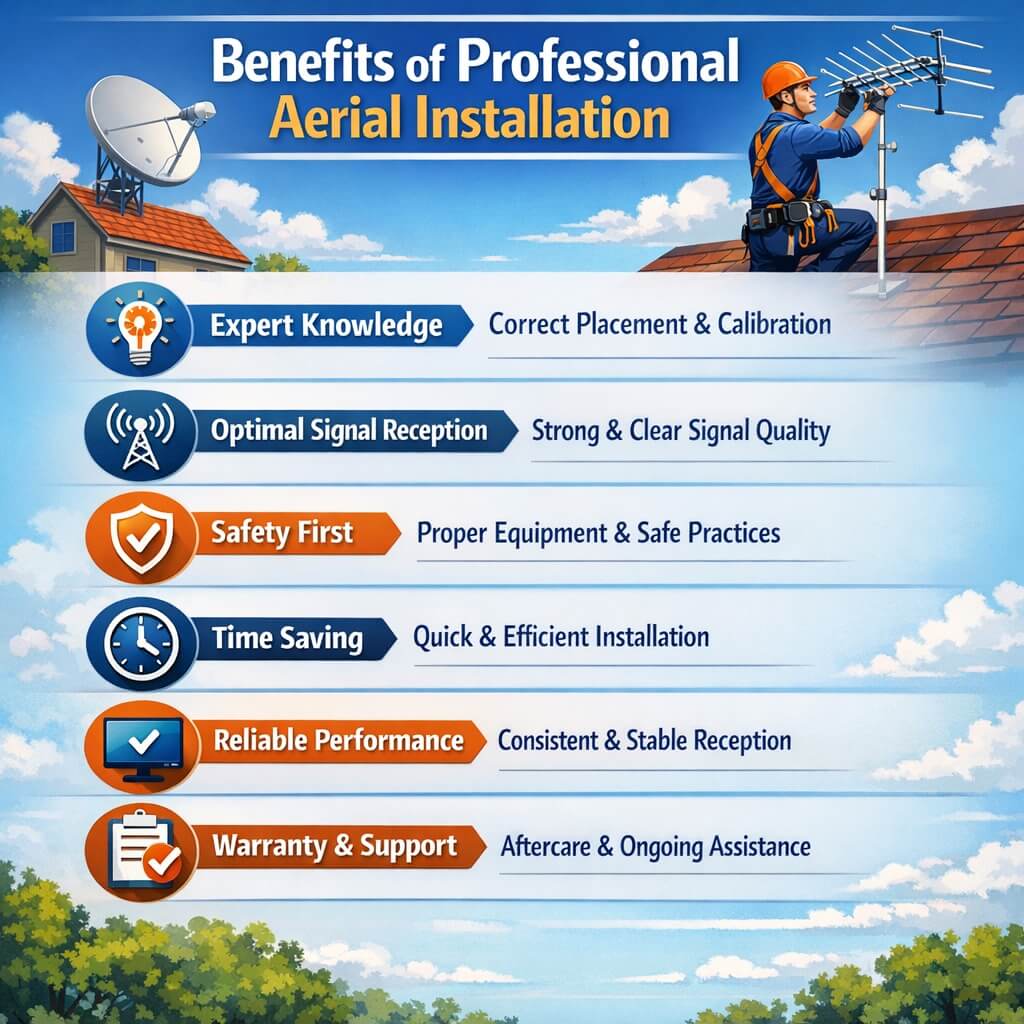
Benefits of Professional TV Aerial Installation
Many homeowners attempt to save money by installing their own aerials, but this approach often leads to subpar results. Professional TV aerial installation offers several distinct advantages that directly impact your viewing experience. First, trained installers use specialized equipment to measure signal strength at your exact location. For instance, a digital signal meter can detect interference from nearby buildings or trees, which is impossible to assess with the naked eye. In the West Midlands, where the Sutton Coldfield transmitter serves a wide area but is obstructed by local terrain, this precision is invaluable.
Second, professional installation guarantees safety. Climbing ladders, working on rooftops, and handling electrical components without proper training can lead to serious accidents. According to the Health and Safety Executive, falls from height remain one of the leading causes of workplace injuries in the UK. A certified installer carries liability insurance and follows strict safety protocols, protecting both your property and your family. I have seen too many DIY attempts result in damaged roof tiles or bent aerials that cost more to repair than the original installation would have.
Third, professionals provide long-term reliability. They use high-grade coaxial cable, weatherproof connectors, and robust mounting brackets that withstand the West Midlands’ frequent rain and wind. A poorly installed aerial might work for a few weeks, but after the first storm, you will likely lose signal. In contrast, a professional job includes a warranty and often a free follow-up visit if issues arise. This peace of mind is worth the investment, especially when you consider that a typical installation lasts for over a decade.
Fourth, expert installers understand the nuances of digital television. The UK’s Freeview platform uses multiple multiplexes, each requiring a specific signal level. A professional will align your aerial to capture all multiplexes, not just the strongest one. This ensures you receive every channel, including HD broadcasts, without pixelation or freezing. I recall a client in Solihull who could only watch BBC One until we realigned their aerial to the correct bearing. After the fix, they gained access to over 70 channels.
Finally, professional installation saves you time. What might take a homeowner an entire weekend to research, purchase, and attempt can be completed in a few hours by an experienced technician. They arrive with the correct mast, brackets, and cable, eliminating multiple trips to the hardware store. When you factor in the cost of your own labour and the potential for mistakes, the professional route is often more economical in the long run.
Common Mistakes to Avoid During TV Aerial Installation
Even with the best intentions, many DIY installers fall into predictable traps that compromise signal quality. One of the most frequent errors is choosing the wrong aerial type. The West Midlands is served by several transmitters, including Sutton Coldfield, The Wrekin, and Ridge Hill. Each transmitter broadcasts on different frequency groups, and using a wideband aerial when a group-specific model is needed can reduce signal strength by up to 30%. I always recommend checking your postcode on the official Freeview checker before purchasing any equipment.
Another common mistake is poor cable management. Using low-quality coaxial cable or failing to seal outdoor connections leads to water ingress, which degrades the signal over time. Water can travel down the cable into your television or set-top box, causing permanent damage. I have repaired dozens of installations where the homeowner used standard indoor cable for outdoor runs. The correct choice is double-screened, weatherproof cable rated for external use, with compression-style connectors that form a watertight seal.
Improper aerial positioning is equally problematic. Many people mount their aerial in the loft to avoid climbing onto the roof, but this almost always results in weak reception. Roof tiles, insulation, and water tanks all absorb or reflect signals, reducing strength by 50% or more. In the West Midlands, where signals must travel through valleys or around hills, loft mounting is particularly ineffective. I advise clients to mount the aerial as high as possible on an external wall or chimney stack, with a clear line of sight to the transmitter.
Neglecting to ground the aerial is another oversight that can have serious consequences. During a lightning storm, an ungrounded aerial can act as a conductor, sending a surge through your television and potentially starting a fire. Professional installers always fit a lightning arrestor or earth block, especially in areas prone to thunderstorms. While the West Midlands does not experience extreme weather as frequently as coastal regions, the risk is still present and should not be ignored.
Finally, many people forget to check for interference from other devices. Mobile phone masts, Wi-Fi routers, and even LED light bulbs can emit radio frequency interference that disrupts your TV signal. A professional installer uses a spectrum analyser to identify these sources and can suggest filters or relocation of equipment. I once solved a mystery signal drop-out in Coventry by moving a baby monitor away from the television. Such small adjustments make a significant difference.
Choosing the Right TV Aerial Installer: 7 Essential Tips
Selecting a reliable installer is critical to achieving a successful TV aerial installation. With so many options available, you need a systematic approach to avoid cowboy operators. Here are seven essential tips I have developed through years of industry experience.
- Verify accreditation and membership — Look for installers who are members of recognised trade bodies such as the Confederation of Aerial Industries (CAI) or the Registered Installer scheme. These organisations require members to follow strict codes of practice and undergo regular training. A CAI-accredited installer, for example, must pass exams on digital reception and safety standards. This accreditation gives you confidence that the work will meet industry benchmarks.
- Check for public liability insurance — Any installer working on your property must have public liability insurance covering at least £2 million. This protects you if they damage your roof, windows, or landscaping during the installation. I always ask to see a copy of the insurance certificate before work begins. If an installer hesitates or makes excuses, walk away immediately.
- Ask for local references — The West Midlands has unique reception challenges, so an installer who works primarily in Birmingham may not understand the terrain in rural Herefordshire. Request references from clients in your specific area. A reputable installer will happily provide contact details for recent jobs. Follow up with those references to ask about punctuality, workmanship, and after-sales support.
- Demand a site survey — Never accept a quote over the phone without a physical inspection. A proper site survey involves climbing onto your roof or using a drone to assess the best mounting location. The installer should also use a signal meter to test reception from different points on your property. If they offer a fixed price without seeing your home, they are likely cutting corners.
- Review the equipment list — Ask exactly which aerial, mast, and cable brands they plan to use. Reputable installers favour brands like Televes, Vision, or Labgear, which are known for reliability. Avoid installers who use generic unbranded components, as these often fail prematurely. I recommend insisting on gold-plated connectors and double-screened cable, as these provide the best signal integrity.
- Get a written guarantee — A professional installer should offer a minimum of two years on parts and labour. Some provide five-year warranties on aerials and masts. The guarantee should be clearly stated on the invoice, including what is covered and how to claim. This protects you if the aerial shifts in high winds or if the cable develops a fault.
- Compare multiple quotes — Obtain at least three quotes from different installers. Be wary of quotes that are significantly lower than the average, as they often indicate cheap materials or rushed work. Similarly, extremely high quotes may not offer better value. A fair price for a standard TV aerial installation in the West Midlands ranges from £150 to £300, depending on the complexity of the job.
Step-by-Step Guide to Fix Poor TV Reception
Before calling an installer, you can troubleshoot poor reception yourself using a systematic approach. I have helped countless neighbours and friends restore their signal with these steps. Start by checking your connections. Loose or corroded coaxial connectors are the most common cause of intermittent signal loss. Unscrew each connector, inspect for rust or bent pins, and tighten them securely. If you find corrosion, replace the connector immediately.
Next, perform a rescan of your television or set-top box. Digital channels change frequencies periodically, especially after transmitter upgrades. In the West Midlands, the Sutton Coldfield transmitter underwent a major retune in 2023, which caused many viewers to lose channels. Go to your TV’s settings menu, select “Tuning” or “Channel Scan,” and choose “Full Retune.” This process can take up to 15 minutes. After completion, check if the missing channels have returned.
If rescanning does not work, check for physical obstructions. Trees that have grown since your original installation may now block the signal. Autumn and winter are particularly problematic because leaves and rain attenuate signals. I recommend trimming any branches that overhang your aerial. If the obstruction is on a neighbour’s property, you may need to discuss relocating the aerial to a different part of your roof.
Consider upgrading your aerial or amplifier. Older aerials designed for analogue signals may not capture digital multiplexes efficiently. A modern high-gain aerial, such as a Log Periodic or Yagi design, can boost reception by 10 dB or more. If you live in a weak signal area, a masthead amplifier mounted near the aerial can compensate for long cable runs. However, be cautious with amplifiers: too much gain can overload your TV’s tuner, causing picture breakup.
Evaluate your cable routing. Long cable runs degrade signal strength, especially if the cable is coiled or runs alongside power cables. I once visited a home in Walsall where the coaxial cable was wrapped around a metal pipe in the loft, causing severe signal loss. Straighten any coils and ensure the cable is at least 30 cm away from electrical wiring. If your cable run exceeds 20 metres, consider using a higher-grade cable with lower signal loss per metre.
Finally, test with a different television or set-top box. A fault in the tuner itself can mimic poor aerial reception. Borrow a portable TV from a friend and connect it to your aerial socket. If the portable TV shows a perfect picture, the problem lies with your original equipment. If the portable TV also shows poor reception, the issue is definitely with the aerial or cable system. This simple test saves you from replacing components unnecessarily.
Comparison: Aerial vs. Satellite Installation
When considering TV aerial installation, you may also wonder about satellite TV installation as an alternative. Both technologies deliver television content, but they operate on fundamentally different principles. A terrestrial aerial receives free-to-air broadcasts from local transmitters, while a satellite dish receives signals from geostationary satellites orbiting 36,000 km above the equator. Each has distinct advantages and limitations that I will compare directly.
Signal reliability — Terrestrial aerials are susceptible to local interference from buildings, trees, and weather. In the West Midlands, heavy rain or snow can temporarily weaken a terrestrial signal, though this is rare. Satellite signals, on the other hand, are highly reliable in clear skies but can be completely blocked by heavy cloud cover or rain fade. I have observed that satellite installations in the region experience about 5 to 10 minutes of signal loss per year during extreme storms, whereas terrestrial losses are more frequent but shorter in duration.
Channel availability — Free