

If you have ever found yourself wondering whether a TV aerial installation is a job you could tackle yourself, or whether it is one of those things best left to a professional, you are in the right place. It is a fair question. From the ground a TV aerial looks straightforward: a metal frame on a pole, a length of cable running into the house, a connection at the back of the TV. How hard can it be?
The honest answer is that it can range from genuinely simple to surprisingly complex, depending on a handful of factors. Some installations are done and dusted in under an hour. Others involve scaffolding, signal analysis, multiple visits and a fair bit of head scratching. After more than 20 years installing TV aerials across Walsall, Wolverhampton, Cannock, Birmingham and the wider West Midlands, we have seen the full spread.
This post explains what actually goes into a TV aerial installation, what can make a job harder than it looks, and what you should be looking for when hiring an installer if you decide it is not one to take on yourself. Think of it as the checklist we would want a relative to use if they were hiring an aerial fitter for the first time.
What an Aerial Installation Actually Involves
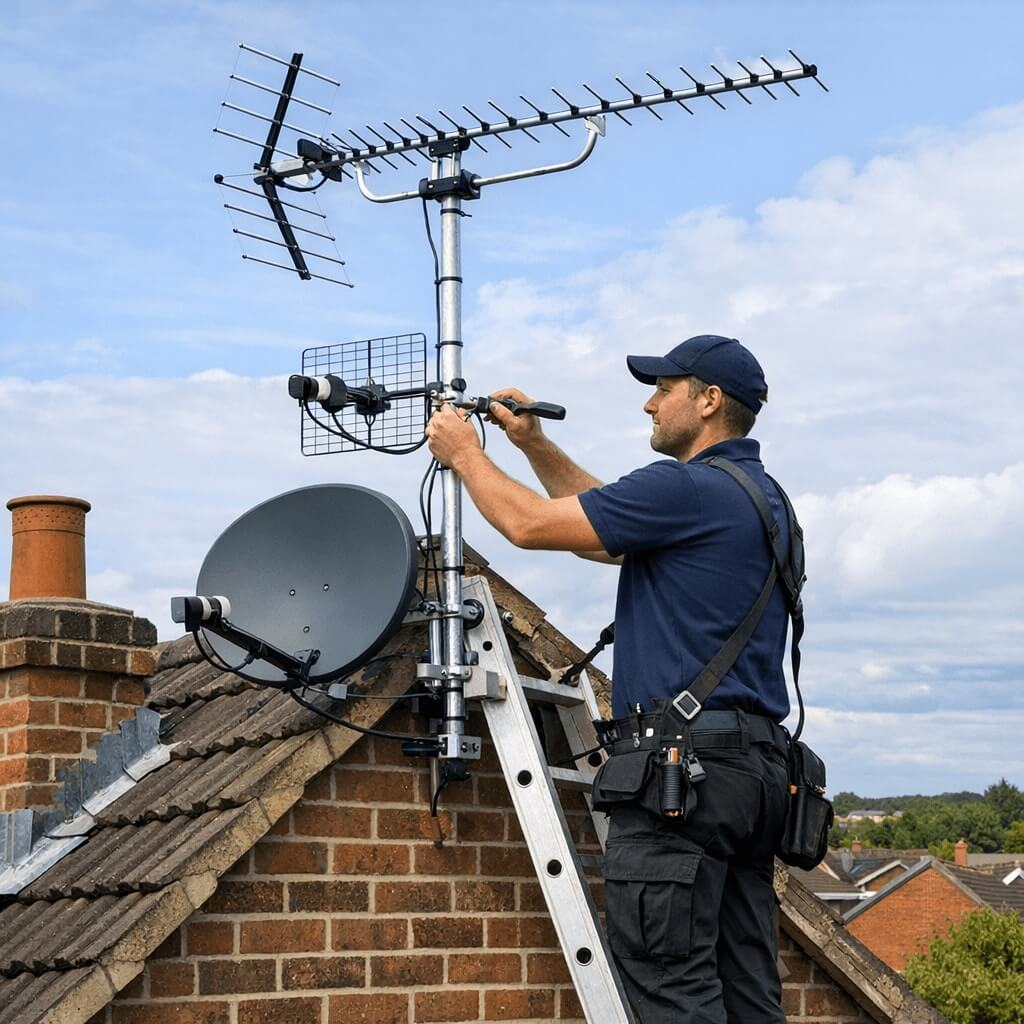
A proper TV aerial installation is more than just bolting a stick to a wall. A good installer will:
- Survey the property and the surrounding area to work out the best mounting position
- Identify the nearest TV transmitter and the polarisation needed for your area
- Choose an aerial that suits the local signal conditions (high gain, wideband, grouped, etc.)
- Mount the aerial on a suitable bracket and pole, using fixings appropriate to the wall surface
- Run good quality coaxial cable from the aerial down to the TV point
- Properly terminate the cable at both ends with weatherproofed connectors
- Test signal strength and quality at every TV point in the property
- Add an amplifier or splitter where multiple rooms are being served, sized correctly so the signal stays strong
- Tune the TV (or TVs) and confirm all Freeview channels are coming in cleanly
- Tidy the cable runs and ensure everything is safe and weather sealed
Skip any of those steps and the install can look fine on day one but cause problems for years.
What Can Make a Job Tricky
The difficulty of an installation comes down to a few things:
Property type and roof access. A bungalow with a low gable end is one thing. A three storey Victorian terrace with a tall stack and no easy ladder access is quite another. Some properties simply cannot be done safely without scaffolding or a cherry picker, and that adds cost and time.
Signal conditions in your area. Some West Midlands postcodes have brilliant coverage and an aerial pointed roughly in the right direction will give you 70 channels. Other locations, particularly in valleys or behind tall buildings, sit in fringe reception areas and need careful aerial selection and aiming.
The transmitter situation. Most of the Midlands is covered by the Sutton Coldfield transmitter, but pockets are better served by Lichfield, Fenton, The Wrekin or others. Pointing at the wrong transmitter, even if the signal looks okay, can mean problems further down the line.
The number of rooms being served. A single TV point is simple. Five TV points across three floors with an amplifier and a splitter is a different prospect, particularly if the cable runs have to go through awkward routes.
The age and condition of the property. Older walls with crumbling brick or pebbledash need different fixings. Listed buildings have restrictions on what can be mounted where. New builds often have pre-installed cabling that may or may not be usable.
The weather and time of year. Working at height on a windy day in February is not the same as on a still summer afternoon. A good installer will reschedule if conditions are unsafe, which is something to bear in mind when planning a job.
A Word on DIY
We are not in the business of putting people off doing things themselves. Plenty of practical homeowners can fit an aerial successfully, and there is no shame in trying. But there are a few things to think about honestly before climbing up:
- Is the mounting position reachable safely from a domestic ladder?
- Do you have, or can you safely use, a tower scaffold or roof ladder if needed?
- Do you have a signal meter, or are you planning to align by trial and error?
- Are you confident terminating coaxial cable with proper F or coax connectors?
- What happens if it doesn’t work first time and you have to keep going up and down?
The biggest hidden cost of DIY is usually time. What a professional does in 90 minutes can take a confident DIYer most of a Saturday, and that is before you factor in the cost of any kit you have to buy that the installer would already own.
The biggest hidden risk is the work at height. Most serious injuries in this trade are from ladder falls, not from electrical issues. If the job involves anything more than a single storey wall mount you can comfortably reach, please think carefully before going up.
Hiring an Installer: What to Look For
If you have decided to bring in a professional, here is what we would suggest you look for. This is essentially the checklist we would want our own family to use.
Qualifications and Experience
Ask how long the installer has been doing the work, and whether they hold any industry accreditation. The most meaningful one in this trade is CAI approval (Confederation of Aerial Industries). CAI approved installers work to a recognised technical standard, carry the right insurance, and are accountable to an industry body. We covered what CAI approval means in detail in our post on becoming CAI approved.
Recommendations and References
Word of mouth still matters in this trade. Ask friends, neighbours and family who they have used and whether they would use them again. Check independent review platforms like Google, Checkatrade or Trustpilot rather than only looking at testimonials on the installer’s own website. Ask for references and actually call one or two if you are planning a bigger job.
Experience With Your Property Type
If you have a particular type of property, ask whether the installer has worked on similar before. A semi-detached brick house is everyday work for any installer. A converted barn, a flat in a 1960s tower block, a thatched cottage, or a building in a conservation area are not. Experience with the specific challenges saves time and avoids surprises.
A Clear Explanation of the Process
A good installer will happily walk you through what they are planning to do before they do it. Where will the aerial be mounted? Why there? Where will the cable run? Are there any choices to make about routing? If the installer is vague or evasive about the plan, that is a warning sign.
Aftercare and Guarantees
Ask what happens if there is a problem in the weeks or months after the job is done. Reputable installers stand behind their work and will return to put things right at no charge if there is a genuine fault. Get the guarantee in writing if possible. Ask which components are covered (the aerial itself, the cable, the connectors, the labour).
Insurance
Public liability insurance is essential for anyone working on your property. If anything goes wrong, whether that is damage to the building or an injury, you do not want to be relying on the installer’s personal savings to put it right. Ask to see proof of cover. A professional installer will not be offended by the question.
A Clear Quote With No Surprises
A proper quote should list what is included and flag anything that might be extra. Common extras include scaffolding, extra cable runs to additional rooms, signal amplifiers, splitters, and disposal of old equipment. Ask up front. The aim is no surprises on the day.
Noise and Disruption
If you have neighbours who are sensitive to noise, particularly in shared walls in flats or terraces, mention it before the day of the install. Drilling into brickwork is loud. A considerate installer will arrange the work to minimise disruption where possible.
Access and Parking
Make sure the installer has parking and access to wherever they need to be. If you are on a permit-only street, sort out a visitor permit beforehand. If trees or shrubs need cutting back to get safe ladder access, do that before the day rather than discovering it on arrival.
What Happens to the Old Equipment
If you are replacing an old aerial, ask what happens to it. Some installers take it away as part of the service. Others leave it for you to dispose of. Neither is wrong, but it is worth knowing in advance.
Timing Expectations
Ask roughly how long the job will take and whether the installer has other commitments that day. A typical single aerial install is often done in 60 to 90 minutes, but anything involving multiple rooms, scaffolding or repair work can take much longer. Knowing the realistic timeframe helps you plan your day.
Trust Your Instincts
This is the soft factor that matters most. After speaking to an installer on the phone or having them visit to quote, do you feel comfortable? Are they responsive, clear, and straightforward? Do they listen to what you are asking for? An installer who is hard work at the quote stage is rarely easier once the job starts.
So How Tricky Is It Really?
The short answer: it depends entirely on the property, the location, the signal conditions and the scope of the work. A simple single TV aerial install on a straightforward semi can be a quick afternoon job. A multi-room install on a difficult property in a poor reception area is real work that requires the right kit and experience.
What we will say is this. The jobs that look easiest from the ground are often the ones that go wrong when done without the right experience. A weak signal, poor cable, badly terminated connectors, or an aerial pointed at the wrong transmitter will all give you the same result: a poor picture that drives you mad. Getting it right the first time, with the right gear and someone who knows what they are doing, is almost always cheaper in the long run than having to put it right.
How R and G Can Help
We have been installing TV aerials across Walsall, Wolverhampton, Cannock, Dudley, Birmingham, Sutton Coldfield and the wider West Midlands for more than 20 years. We are CAI Plus approved, fully insured, and we work to the standards the industry expects. We carry proper signal meters, we use CAI specification cable, and we stand behind everything we install.
We are happy to quote any job, big or small, with no obligation. To talk through your install or book a survey, give us a call on 01922 302195 or 01922 302129, email info@randgsatelliteservices.co.uk, or request a free quote online.
You can also browse our main TV aerial installation page for more detail on what is included as standard, or have a look at our aerial repairs page if you have an existing aerial that has stopped working properly.